The six classic kinship systems on one family tree
Inuit, Hawaiian, Sudanese, Iroquois, Crow and Omaha terms on one family tree: who gets called what, what each merges, and where the labels came from.
 Ines Valdera · · 9 min read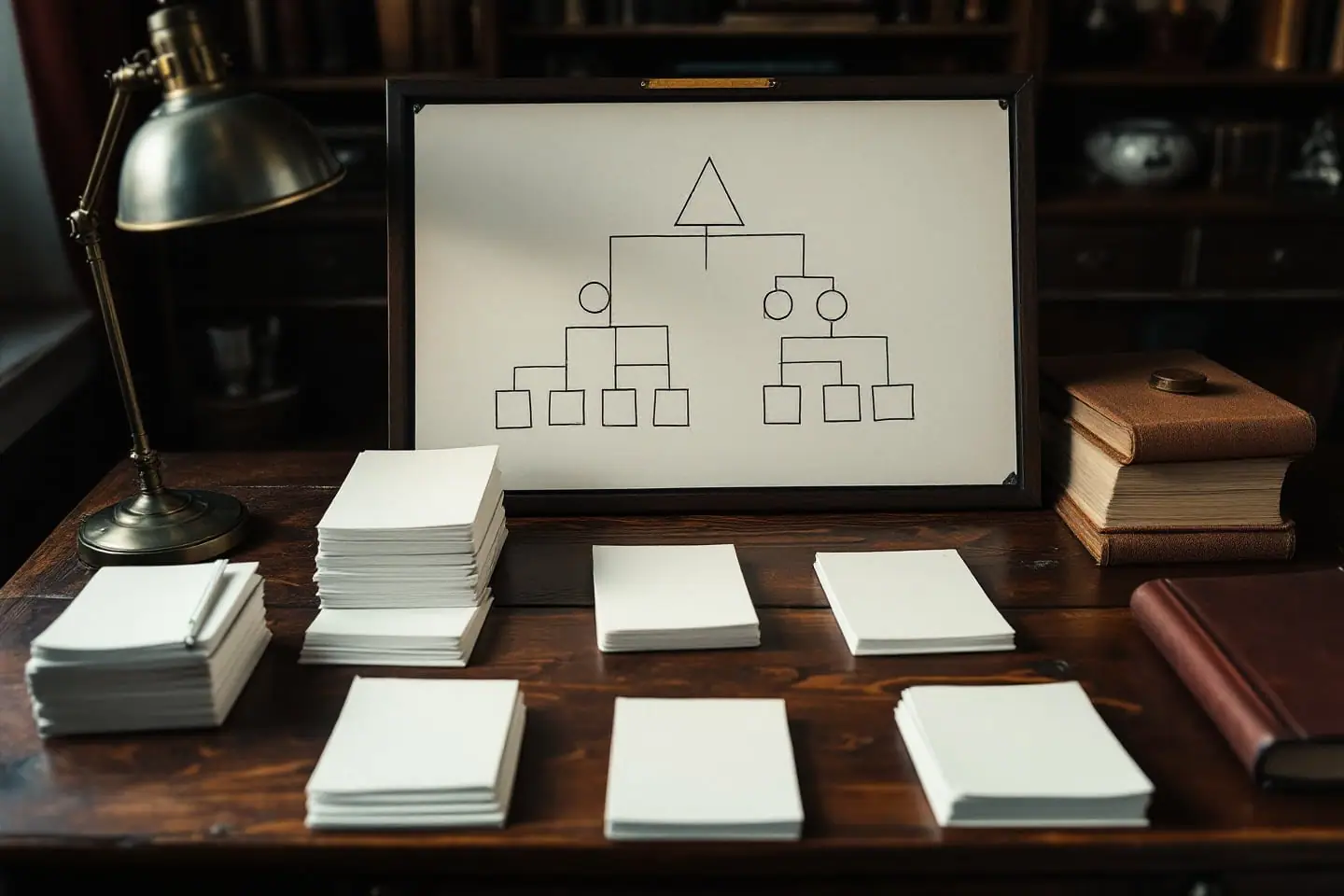
Every language has to decide which relatives share a word. English puts your father's brother and your mother's brother under one word, "uncle", and it lumps all four kinds of first cousin together as "cousin". Plenty of languages draw those lines somewhere else, and anthropologists have spent a century and a half sorting the results. The best-known sorting has six patterns, usually called Inuit (or Eskimo), Hawaiian, Sudanese, Iroquois, Crow and Omaha. Here all six go on a single family tree, so you can see exactly what each one merges and what it keeps apart.
First, the shorthand. Kin types are written as strings of letters read outward from the person doing the naming, who is called Ego: F father, M mother, B brother, Z sister, S son, D daughter, H husband, W wife, with e and y for elder and younger when age matters. So MBD is "mother's brother's daughter" and FZ is "father's sister". The full set of conventions is in our notation guide.
The family we will name
Picture one Ego, a man (the reason for choosing a man comes later). He has a father, a mother, a brother and a sister. His father has one brother and one sister; his mother has one sister and one brother. Each of those four aunts and uncles has a daughter. That gives twelve relatives besides Ego:
- the parents' generation: F, M, FB, FZ, MB, MZ
- Ego's own generation: B, Z, FBD, MZD, FZD, MBD
The four cousins fall into two pairs. FBD and MZD are parallel cousins: the parents who link Ego to them are siblings of the same sex (two brothers, or two sisters). FZD and MBD are cross cousins: the linking parents are a brother and a sister. Keep that split in mind, because it does most of the work in what follows.
Who is called what
The table gives each system's term in an English gloss. A word in quotation marks means the relative is called by that kin term although, by genealogy, they are someone else. "Own term" means a word that, within this table, belongs to that relative alone.
| Relative | Inuit (Eskimo) | Hawaiian | Iroquois | Sudanese | Crow | Omaha |
|---|---|---|---|---|---|---|
| F | father | father | father | father | father | father |
| FB | uncle | "father" | "father" | own term | "father" | "father" |
| MB | uncle | "father" | own term | own term | own term | own term |
| M | mother | mother | mother | mother | mother | mother |
| MZ | aunt | "mother" | "mother" | own term | "mother" | "mother" |
| FZ | aunt | "mother" | own term | own term | own term | own term |
| B, Z | brother, sister | brother, sister | brother, sister | brother, sister | brother, sister | brother, sister |
| FBD | cousin | "sister" | "sister" | own term | "sister" | "sister" |
| MZD | cousin | "sister" | "sister" | own term | "sister" | "sister" |
| FZD | cousin | "sister" | cross-cousin term | own term | "father's sister" | "sister's daughter" |
| MBD | cousin | "sister" | cross-cousin term | own term | "daughter" | "mother" |
Two cautions. The parents' generation rows show the usual textbook pairing; the six types themselves are defined by the cousin rows, and real languages mix and match above them. And the Crow and Omaha entries are for a male Ego. A woman in a Crow system calls her MBD by the word she uses for her brother's daughter, not "daughter".
What each system merges and splits
Inuit (Eskimo)
This pattern draws a firm line around the nuclear family. Father, mother, brother and sister each get a word that nobody else shares. Everyone outside that circle is sorted by generation and sex only, with no attention to which parent links them, so FB and MB are both "uncle" and all four cousins are "cousin". English works this way, which is why the pattern can feel like common sense to English speakers. It is one choice among several.
Hawaiian
Hawaiian merges the most. Only generation and sex count: every man of the parents' generation is "father", every woman "mother", and every relative of Ego's own generation is "brother" or "sister". Lewis Henry Morgan took the Hawaiian form as the typical case of a family of systems he called "Malayan", and he considered it the simplest classificatory form. A shared word does not mean speakers cannot tell their birth mother from her sister. It means the everyday vocabulary does not force the distinction.
Iroquois
Here the sex of the linking parent matters. F and FB share a word, as do M and MZ, while MB and FZ get words of their own. In Ego's generation the same logic puts parallel cousins with brothers and sisters and gives cross cousins a separate term, one word covering both FZD and MBD. Morgan used the Seneca, one of the Iroquois nations, as his model of what he called the American Indian form. The Dravidian systems of South India make the same first-cousin split but compute it differently for more distant cousins, which our note on Dravidian terminology explains.
Sudanese
The opposite of Hawaiian: many separate words. George Peter Murdock's definition requires only that FZD and MBD be named differently from each other and from sisters, parallel cousins, aunts and nieces. In practice such systems usually lean on descriptive terms, compounds built from basic words in the manner of "father's brother's daughter", and the table shows that fully descriptive version.
Crow
Crow starts like Iroquois, then pulls the father's sister's line out of Ego's generation altogether. FZD is called by the same word as FZ, and her brother, FZS, is called "father". On the mother's side the skew runs the other way: a man calls MBD by the word he uses for his own daughter. Murdock grouped Crow with societies of matrilineal or double descent. The usual reading is that a father's sister and her daughter belong to the same matrilineage, the father's, so one word covers its women whatever their generation.
Omaha
Omaha is the mirror image. The mother's side is skewed: MBD is called "mother" and MBS "mother's brother", while a man calls FZD by his word for his sister's daughter. Murdock counted Omaha among the stable patrilineal types, and the lineage reading flips accordingly: the mother's patrilineage supplies "mothers" and "mother's brothers" in every generation. Crow and Omaha terms have attracted some of the most formal work in the field, and our note on Crow-Omaha generative logic follows one line of it.
Counting the possibilities
A terminology can be treated as a way of cutting a set of relatives into labelled blocks. Mathematicians call such a cut a partition, and the number of partitions of n things is the Bell number B(n).
Start with three relatives: Ego's sister Z, one parallel cousin P and one cross cousin C. Every partition of the three is on this list:
- {Z, P, C}: one word for all three. Hawaiian.
- {Z, P} {C}: Iroquois, and also Crow and Omaha within Ego's generation.
- {Z} {P, C}: Inuit.
- {Z} {P} {C}: three separate words. Sudanese.
- {Z, C} {P}: sister merged with the cross cousin, the parallel cousin set apart. None of the six.
So B(3) = 5, and four of the five cuts are named types.
Now take all five women of Ego's generation: Z, FBD, MZD, FZD and MBD. Bell numbers obey the recurrence B(n+1) = sum over k of C(n, k) × B(k), for k from 0 to n, starting from B(0) = 1:
- B(1) = 1
- B(2) = 1 + 1 = 2
- B(3) = 1 + 2 × 1 + 1 × 2 = 5
- B(4) = 1 + 3 × 1 + 3 × 2 + 1 × 5 = 15
- B(5) = 1 + 4 × 1 + 6 × 2 + 4 × 5 + 1 × 15 = 52
Fifty-two possible cuts, and the six classic types use only five of them. Crow and Omaha cut Ego's generation identically, {Z, FBD, MZD} {FZD} {MBD}, and differ only in which words they borrow from other generations. Languages could in principle pick any of the 52. They cluster on a handful, and explaining that clustering through descent and marriage rules was the core of Murdock's project.
Where the labels came from
Morgan gathered kin-term schedules from around the world and published them in Systems of Consanguinity and Affinity of the Human Family, issued by the Smithsonian Institution in 1871. He sorted everything into two great classes. Descriptive systems keep collateral relatives apart from lineal ones, often by compound phrases. Classificatory systems merge them, as when FB is called "father". Within the classificatory class he set the Seneca form as typical of American Indian systems, the Hawaiian form as typical of his "Malayan" family, and treated an "Eskimo" system as a case of its own.
Leslie Spier (1925) classified North American systems mainly by their cousin terms and named types after particular peoples. Robert Lowie (1928) proposed four patterns for the parents' generation, which the table's top rows follow: lineal (Inuit), generational (Hawaiian), bifurcate merging (Iroquois, Crow, Omaha) and bifurcate collateral (Sudanese). Then Murdock, in Social Structure (1949), surveyed 250 societies and settled on six types defined by the treatment of cross cousins. He kept Spier's names for Crow, Eskimo, Iroquois and Omaha, adopted "Hawaiian" for what Spier had divided among several types, and named "Sudanese" after the region where he found it most often. His definitions rest on the terms a man uses for female relatives, because that is what his survey recorded, and that is why the Ego in our tree is a man.
The trouble with the old names
The labels are historical accidents, and three of them deserve a warning.
"Eskimo" is an outsiders' name. Lawrence Kaplan of the Alaska Native Language Center explains that many Alaska Natives regard it as an imposed colonial name and that "Inuit" is now the usual term across the Arctic, while noting that Yupik peoples are related to Inuit but distinct. Many teachers now write "Inuit" or simply "lineal". We use "Inuit (Eskimo)" so that readers can match older textbooks.
"Sudanese" names a region, not a people, and gathers very different societies under one geographic word.
The tribal names (Iroquois, Crow, Omaha, Hawaiian) each come from one documented case. The danger is reading the label as a description of a living community today, when it refers to a pattern recorded at a particular time, in a particular language, by particular observers.
How common is each pattern?
Murdock went on to code societies for his Ethnographic Atlas, now available through the D-PLACE database. Its cousin-terms variable (EA027) splits his Sudanese type into "descriptive" and a narrower "Sudanese", and adds "mixed". The counts below are as D-PLACE reports them; the percentages are ours.
| Type (Atlas code) | Societies | Share of coded societies |
|---|---|---|
| Hawaiian | 338 | 35.4% |
| Iroquois | 256 | 26.8% |
| Eskimo | 110 | 11.5% |
| Descriptive | 81 | 8.5% |
| Omaha | 79 | 8.3% |
| Crow | 58 | 6.1% |
| Mixed | 18 | 1.9% |
| Sudanese | 15 | 1.6% |
| Total | 955 | 100% |
Read these as counts in one coded sample, not as shares of humanity. The Atlas over-represents some regions, neighboring and related societies share patterns through common history, and every code compresses a messy vocabulary into one box. What the numbers do show is that the pattern English speakers find natural is far from the most common one in the sample: Hawaiian and Iroquois together account for 594 of the 955 societies. To see all six patterns redrawn on a tree you can click through, open the kinship terms chart and switch between systems while watching the FZD and MBD boxes.
Sources and further reading
- Morgan, Lewis Henry. 1871. Systems of Consanguinity and Affinity of the Human Family. Smithsonian Contributions to Knowledge 17. Washington: Smithsonian Institution. https://archive.org/details/systemsofconsang00morgrich
- Spier, Leslie. 1925. "The Distribution of Kinship Systems in North America." University of Washington Publications in Anthropology 1: 69 to 88.
- Lowie, Robert H. 1928. "A Note on Relationship Terminologies." American Anthropologist 30 (2): 263 to 267. https://doi.org/10.1525/aa.1928.30.2.02a00060
- Murdock, George Peter. 1949. Social Structure. New York: Macmillan. https://archive.org/details/socialstructurem00murd
- Kaplan, Lawrence. "Inuit or Eskimo: Which Name to Use?" Alaska Native Language Center, University of Alaska Fairbanks. https://uaf.edu/anlc/resources/inuit-eskimo/
- Kirby, Kathryn R., Russell D. Gray, Simon J. Greenhill and others. 2016. "D-PLACE: A Global Database of Cultural, Linguistic and Environmental Diversity." PLOS ONE 11 (7): e0158391. https://doi.org/10.1371/journal.pone.0158391
- D-PLACE. "Kin terms for cousins [EA027]." https://d-place.org/parameters/EA027