Methods & ToolsKinship & Family Structures
Kinship chart vs family tree: the difference, the symbols and how to make one
How a kinship chart differs from a family tree, the symbols each convention uses, when to use which, and how to turn a family tree into a kinship chart.
 Leila Farzan · · 9 min read
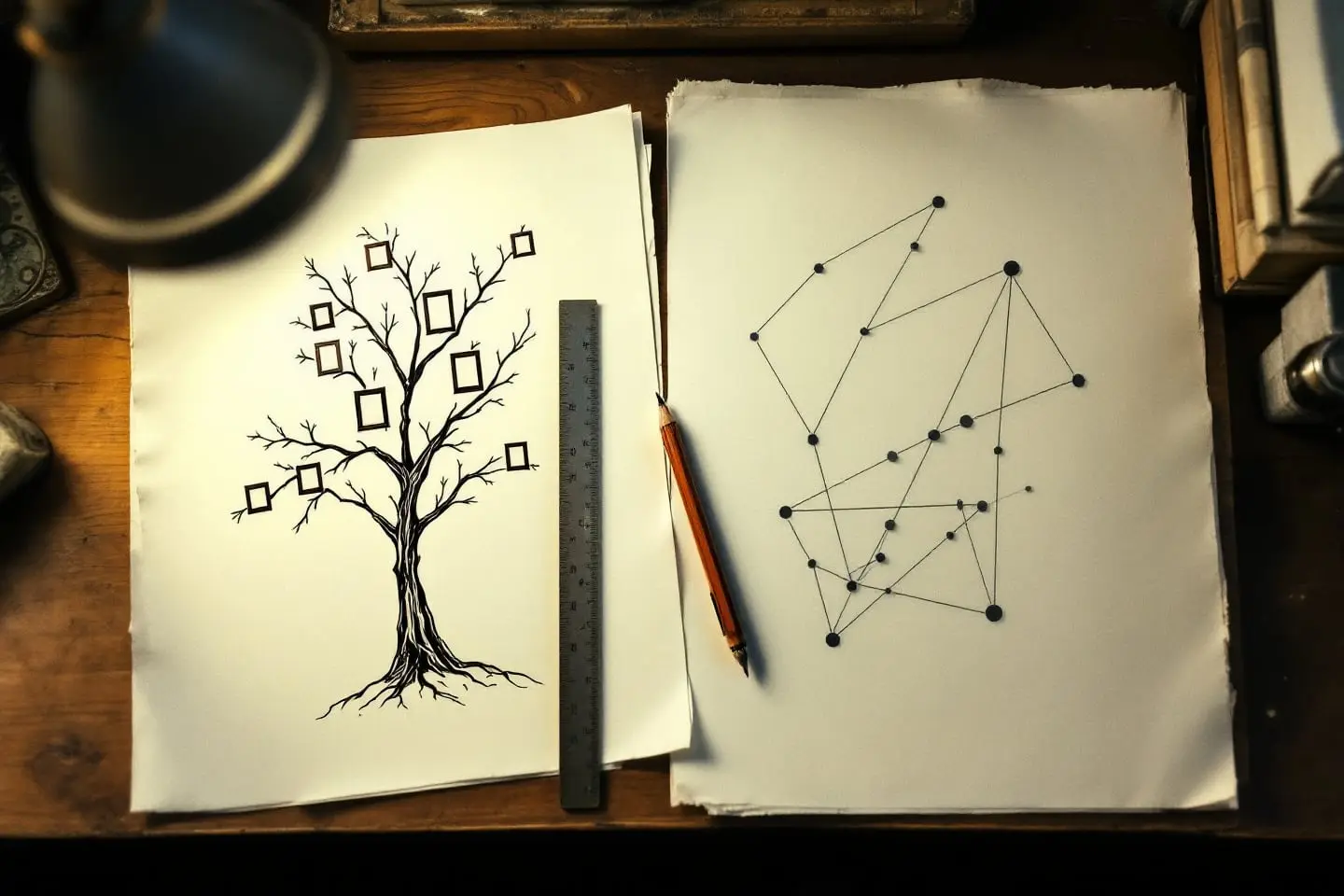
A family tree records particular people, usually with names, dates and places, to document who descends from whom. A kinship chart maps relationships outward from one reference person, called Ego, with standard symbols and kin-type or kin-term labels, so you can see how every relative is connected to Ego and what Ego calls them. Both are drawn from the same facts about births and marriages, but they answer different questions, and that difference decides what goes on the page.
The difference at a glance
| Family tree | Kinship chart | |
|---|---|---|
| Main question | Who were my ancestors, and how do I know? | How is each person related to Ego, and what is each one called? |
| Built around | a line of ancestors or one ancestor's descendants | a single reference person, Ego |
| Who appears | mainly direct ancestors and their spouses, or descendants | relatives in every direction: siblings, cousins, in-laws, step relations |
| Labels | names, dates, places | kin types such as MBD, kin terms, or symbols alone |
| Shapes | boxes or plain names | triangles, circles, an equals sign for marriage, lines for descent and siblings |
| Backed by | a record cited for each fact | an interview, a terminology, or a model with no real people in it |
| Usual home | family history and genealogy software | anthropology and sociology courses, fieldwork notes |
The "backed by" row matters more than it looks. Many kinship charts show nobody real at all. A textbook chart of an Iroquois-type terminology is a model of a family, used to show which positions share a word, and no family tree works that way.
What genealogists mean by a family tree
Family historians use several formats. An ancestor chart, often called a pedigree chart, starts from one person and branches back through parents and grandparents, so it widens as it climbs. A descendant chart starts from an ancestor and spreads downward. A fan chart draws the ancestors in concentric half rings. An ahnentafel (German for "ancestor table") skips the drawing altogether and lists ancestors by number.
The ahnentafel is a neat piece of arithmetic. The starting person is number 1. The father of person n is 2n and the mother is 2n + 1, so the parents are 2 and 3, the grandparents 4 to 7 and the great-grandparents 8 to 15. Generation g back holds 2^g places, numbered 2^g to 2^(g+1) - 1, and apart from number 1 every father has an even number and every mother an odd one. The scheme goes back to Michaël Eytzinger in 1590; Jerónimo de Sosa popularized it in 1676 and Stephan Kekulé von Stradonitz published his version in 1898, which is why genealogists also call it Sosa or Sosa-Stradonitz numbering.
Worked example: who is number 13?
- Write 13 in binary: 1101.
- The leading 1 is the starting person. Read the remaining digits left to right, with 0 for father and 1 for mother: 1, 0, 1.
- That spells mother, father, mother. In kin-type letters, MFM: the mother's father's mother.
- Four binary digits means three generations back, so she is a great-grandmother.
- Check it forward: mother is 3, her father is
2 × 3 = 6, his mother is2 × 6 + 1 = 13.
The example also shows the real limit of a family tree. MFM's sister has no number. The scheme has room only for direct ancestors, while a kinship chart would draw her and ask what Ego calls her. And a real family is not a tree in the mathematician's sense once relatives marry each other, because the same ancestor can then be reached along two paths and earns two numbers. Ancestry is a network without loops rather than a tree, and the pedigree collapse calculator shows how fast those repeated ancestors pile up.
The symbols, convention by convention
There are three common drawing conventions, and they disagree in places. Anthropological kinship charts use triangles and circles. Clinical pedigrees, used by genetic counselors, follow the National Society of Genetic Counselors' standard, first published in 1995, updated in 2008, and revised in 2022 with a focus on how sex and gender are shown. Genealogy charts mostly use boxes with text.
| Element | Kinship chart (anthropology) | Clinical pedigree (genetics) | Family tree (genealogy) |
|---|---|---|---|
| male | triangle △ | square □ | a box with a name |
| female | circle ○ | circle ○ | a box with a name |
| sex unknown | diamond ◇, sometimes a square | diamond ◇ | usually nothing special |
| marriage | = between the two symbols | horizontal line between partners | the two names joined, often with a date |
| children | vertical line from the marriage | vertical line down to a sibship line | branching lines |
| siblings | horizontal bar | sibship line, oldest on the left | listed under the parents |
| deceased | slash through the symbol or shading | diagonal line through the symbol | a death date |
| reference person | Ego, filled or labeled | proband, marked with an arrow | the starting person, number 1 |
| generations | rows marked G+1, G0, G-1 | Roman numerals I, II, III | rows, often unmarked |
| labels | kin type or kin term | numbers within each generation, filled symbol for an affected person | names, dates, places |
The trap is the square. On a clinical pedigree it means a male; on some anthropology charts it means sex unknown. Neither is wrong, so a chart without a key is the only real error.
A fourth form, the genogram, starts from the same kind of family drawing and adds information about how family members get along and which patterns repeat across generations. The family therapist Murray Bowen developed the idea in the 1970s, and Monica McGoldrick and Randy Gerson popularized it with a 1985 book; it is now used in family therapy, social work and family medicine.
When to use which
- You want to document ancestors, cite a record for every date and share the result with relatives: a family tree, kept in a genealogy program so the data can be exported.
- You are studying how people classify relatives, or your course asks for "your kinship chart": a kinship chart labeled with kin types.
- You are comparing terminologies, such as Iroquois against Inuit (Eskimo): a model chart with no real people, like the kinship terms chart.
- A doctor or genetic counselor wants a family health history: a pedigree in the clinical symbols.
- A therapist or social worker is mapping relationships inside a family: a genogram.
How to make a kinship chart, step by step
Most students do not start from nothing. They already have a family tree, in an app or on paper, and need to turn it into a kinship chart. Here is that conversion with a hypothetical example: a student, whom we will treat as Ego, a woman, whose tree lists her parents, her mother's parents, her mother's sister with that sister's husband and son, her father's brother, and her own brother and his wife.
Step 1: fix Ego and the question
Ego is the student. The question is what she calls each relative, and how another terminology would group the same people. Write both at the top of the page, because they decide what to include.
Step 2: set the scope by order of relationship
Decide how far out to go. A common limit is three orders: primary relatives (Ego's parents, siblings, spouse and children), secondary relatives (their primary relatives, such as grandparents, aunts, uncles and a brother's wife) and tertiary relatives (one step further, such as first cousins and an aunt's husband). The guide to primary, secondary and tertiary relatives explains the counting. At this stage the gaps in the tree show up. Ancestor-focused trees often leave out siblings and in-laws, so ask about them.
Step 3: replace names with kin types
Make a table first and draw second. The names stay in the tree; the chart gets kin types. The address forms in the last column are what our hypothetical student reports.
| In the tree | Kin type | Order | Ego's term (reference) | What she says to them |
|---|---|---|---|---|
| father | F | primary | father | Dad |
| mother | M | primary | mother | Mom |
| brother | B | primary | brother | his first name |
| brother's wife | BW | secondary | sister-in-law | her first name |
| mother's father | MF | secondary | grandfather | Grandpa |
| mother's mother | MM | secondary | grandmother | Grandma |
| mother's sister | MZ | secondary | aunt | Aunt plus first name |
| her husband | MZH | tertiary | uncle | Uncle plus first name |
| their son | MZS | tertiary | cousin | his first name |
| father's brother | FB | secondary | uncle | Uncle plus first name |
The notation guide lists every kin-type letter and the conventions for elder, younger and speaker's sex.
Step 4: pick a convention and draw the key
Triangles for males, circles for females, a diamond for anyone whose sex you do not know, a slash for the dead, Ego filled. Put the key on the same page as the chart.
Step 5: lay it out by generation
One row per generation: grandparents (G+2), parents and their siblings (G+1), Ego with her brother and cousin (G0). Place couples first, then hang children from the middle of each marriage line. The explainer on how to draw a kinship diagram walks through a full eighteen-person drawing and the mistakes beginners make.
Step 6: add the terms layer
Write the kin type above each symbol and Ego's term below it. Now the chart shows something the family tree could not: FB and MZH both get "uncle", although one is a blood relative and the other married in, and MZS gets "cousin" without any hint of which side he is on.
Step 7: compare with another terminology
Keep the drawing and swap the words. In an Iroquois-type terminology, MZ would be called by the word for mother, MZS by the word for brother and FB by the word for father, while MB and FZ keep separate terms. Seeing those changes on a drawing you made yourself is usually the point of the assignment.
Questions
Is a pedigree chart the same as a family tree?
In genealogy, a pedigree chart is one kind of family tree, the ancestor chart. In medicine, a pedigree is the squares-and-circles diagram used to follow a health condition through a family. Same word, different conventions.
Can one diagram be both a family tree and a kinship chart?
Yes. A genealogy of real people drawn with anthropological symbols is both, and fieldworkers have collected such genealogies since W. H. R. Rivers described his genealogical method in 1910. The difference is then in what you write on it and what you ask of it.
Do I need special software?
No. Pencil and squared paper are the fastest tools while you are still asking questions. Genealogy programs draw family trees from stored data; for a kinship chart a general drawing program is enough, provided you keep the table from step 3 alongside it.
Sources and further reading
- Bennett, R. L., French, K. S., Resta, R. G., and Doyle, D. L. (2008). Standardized human pedigree nomenclature: update and assessment of the recommendations of the National Society of Genetic Counselors. Journal of Genetic Counseling 17(5): 424-433. doi.org/10.1007/s10897-008-9169-9
- Bennett, R. L., French, K. S., Resta, R. G., and Austin, J. (2022). Practice resource-focused revision: standardized pedigree nomenclature update centered on sex and gender inclusivity. Journal of Genetic Counseling 31(6): 1238-1248. doi.org/10.1002/jgc4.1621
- Rivers, W. H. R. (1910). The genealogical method of anthropological inquiry. The Sociological Review 3(1): 1-12. doi.org/10.1111/j.1467-954X.1910.tb02078.x
- Schusky, Ernest L. (1965). Manual for Kinship Analysis. New York: Holt, Rinehart and Winston.
- McGoldrick, Monica, Randy Gerson, and Sueli Petry (2020). Genograms: Assessment and Treatment, 4th edition. New York: W. W. Norton.
- Wikipedia contributors. Ahnentafel; Pedigree chart. en.wikipedia.org/wiki/Ahnentafel